
A Gamified Pitch-Training App that Teaches Anyone to Sing in Tune
Project Overview
Many people say they can't sing, but what they are lacking is the feedback that help them build confidence and improve.
"Stay Steady, Don't Go Off-Key!" (稳住,别跑调! ) is a game-based pitch-training app that teaches anyone to sing in tune, in real time, using only a phone microphone.
It has reached 50,000 users, 300,000 views and 3,587 likes on Rednote.
Context
Passion Project, launched as a mini tool on Chinese Social Media Platform, Rednote
Audience
Beginners and self-described "tone-deaf" singers, Chinese-speaking
Type
Concept, learning design, UX/UI and front-end build
My Role
Sole Designer and Developer
Tools
Claude Design and Claude Code
My Responsibilities
Design, Development, Promotion, Evaluation, Testing, Iteration
Design Highlights
The app grew out of a request from a user of my earlier app. My earlier app, "Seven-Note Whack-a-Mole", teaches learners to link do-re-mi with sound by ear: they hear a note and identify it. After launch, a user asked for the next step: "Can it teach me to sing do re mi too?"
That question showed a gap. Recognizing a pitch and producing it are separate skills, and learners who can do the first still need practice with the second. This app was built as a companion to answer the problem.
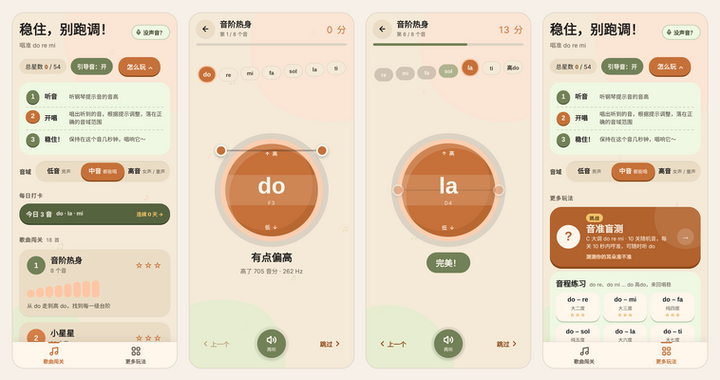
Left to right: Home, Live feedback, Note locked, More modes.
1. The method on the home screen. Listen → Sing → Hold appears as three numbered steps before any song. Range picker, guide-tone toggle and the daily streak sit above the song list. Each song card shows its melody contour as bars and a one-line tip on the skill it trains.
2. One big target, read at a glance. A large ring shows the target note in solfège with the letter name underneath. A marker slides up or down against ↑ high / ↓ low cues, and plain words ("a little sharp") come with the exact cents for learners who want them.
3. Progress you can see. The note chips across the top fill in as you go and the progress bar grows, so every scale reads as small steps up. A held note earns a green "Perfect!"
4. Choices without clutter. Extra modes live in a second tab: the Blind Pitch Test as a featured challenge card, interval drills as a grid of tiles with star ratings, and Free Mode.The warm palette (terracotta, sage, cream) and soft round shapes feel calm and playful, not like an exam. Big tap targets and a bottom tab bar make it easy to use with one hand while singing.
Analysis
Problem
Most people who say they "can't sing" have never had feedback precise enough to learn from. Singing in tune is a perception-and-correction skill, but beginners rarely get to practice it.
-
No feedback loop. Learners can't hear their own errors in the moment, so they can't correct them. A teacher gives that feedback, but lessons cost money and happen once a week.
-
Anxiety blocks practice. Fear of sounding bad keeps people from singing at all, and singing is the only way to get better.
-
Existing tools are built for musicians. Tuners and pitch apps show raw frequencies and note names. Nothing guides a novice from "can I make a sound?" to singing a whole song in tune.
Audience
The primary learner is an adult or teen beginner with no music training, often someone who has been told they sing off-key. They practice alone, on a phone, in short sessions.
Design Goals
-
Make the first win immediate. Anyone who makes a sound passes the first lesson.
-
Give instant, precise feedback that a non-musician can act on: higher, lower or steady.
-
Scaffold from single notes to intervals to full songs, so difficulty grows with skill.
-
Make practice a habit, not a one-time try.
-
Work for every voice. Low, mid and high ranges, and any octave that is in tune counts.
Solution
Every exercise runs on one three-step loop: Listen (a piano plays the target note), Sing (a live marker shows whether you are sharp or flat), then Hold (stay on the note for a few seconds to lock it in). The app picks up pitch from the mic in real time and scores how close you are in cents.
Rationale
The design rests on one research finding: most poor-pitch singers are not tone-deaf. Their ears work, but they have trouble turning a heard pitch into the right vocal action (Pfordresher & Brown, 2007). Only a small minority have true amusia. So the app treats singing in tune as a sensorimotor skill that improves with feedback, not a fixed talent.
Design and Development Process
Fast Iteration with AI Tools
I use Claude Design and Claude Code throughout my design and development process. I first mapped the key features I want, which are pitch recognition and correction, then iterate based on real user feedback.
Implementation
The app is a lightweight, dependency-free web app: one HTML page, one stylesheet and about 115 KB of plain JavaScript, delivered as a Rednote mini-tool. Everything runs on the device, with no server and no audio uploaded.
Impact
The app reached 50,000 users, along with 300,000 views and 3,587 likes on Bilibili. About 1 in 6 viewers went on to use the app, which suggests the concept meets a real need among people who want to sing better.
Open question: add retention or learning-outcome data if you have it, such as streak length, completion rate or score gains between first and later attempts.
Future Considerations & Key Takeaways
The biggest lesson was that the barrier for beginners is emotional before it is technical. A guaranteed first win and warm, specific feedback mattered as much as accurate pitch detection.
Real-world audio was the hardest part to design for. Bluetooth headphones, blocked mics and the app going to the background all break the experience. A guided sound check and plain-language fixes made the app usable for a general audience.
Next steps:
-
Track learning outcomes, such as accuracy gains per user over time, to show skill growth and not just engagement
-
Add adaptive difficulty that adjusts tolerance and hold time to each learner's level
-
Expand the content to rhythm, harmony singing and more song genres